

2016 Boat Trip: Part 2

Previously on…
There we were, sitting in the cockpit of our rollicking sailboat, a meteor having just streaked across the sky.
The boat had rocked and rolled all night long, overwhelming us with nausea. The moment the sun peeked over the horizon, we took off, ready to leave this anchorage behind forever.
Kadin set our course on the chart plotter, and began steering us south towards Norfolk, Virginia. As the sun climbed higher the wind receded, but the steady lope of the boat maintained the sloshing of my insides like one of those desktop pendulum toys.
I snuggled down on one of the settees in the cockpit, taking time to rest and compose myself. (I couldn’t be inside the boat while the diesel motor was running because it was like being trapped with a lawnmower in a small room. Plus it stank of diesel and made the interior 10 degrees hotter than it would have been otherwise.)
After about an hour or so, I sat up and looked at the chartplotter to check our progress. A kind of silent “are we there yet.” The red line that keeps track of where we’ve been had turned into a circle. I looked over my shoulder at Kadin. He was standing behind the wheel, straw hat on to protect him from the sun, and his eyes were completely vacant. He wasn’t asleep, but he may as well have been. I pointed out the pretty picture he had made on the chartplotter, and convinced him that he needed to take a break. I took over, keeping the sun to the leftish side of the boat.

Traversing the Intracoastal Waterway
It was deep into the afternoon by the time we left the Chesapeake and entered the Elizabeth River, the mouth of which is bordered by the City of Norfolk to the north and the smaller city of Portsmouth to the south. The Norfolk side is dominated by massive military vessels and shipping freighters, and on both shores there were hundreds of different boats tied off at docks and moorings, many of them gorgeous sailing yachts.
Here we were puttering along, no sails on our sailboat, paint faded, and a tarp slung over our boom and lashed down with bungee cords as a Jerry-rigged shade structure. We looked like the Beverly hillbillies of sailing. Kadin’s straw hat didn’t help matters.
We navigated our way down the river carefully until we reached the city dock of Portsmouth. I don’t have enough experience at this point to say with any real authority, but so far this was the coolest public dock I have ever seen. It was built something like an amphitheater; horseshoe shaped, and a recessed concrete walkway with stairs that take you to street level. When you reach the top of the steps, you find yourself in the middle of a city with tree-lined streets, tall buildings, and restaurants. Lots of restaurants. I could smell them.
We were still exhausted and a little nauseous, but it was nearly 100 degrees outside, so hanging out in the boat and steaming like we were in a greenhouse was not an attractive way to spend our time. Instead, we got spiffied up and went on the hunt for nourishment. We splurged on huge, overpriced burgers with steak-cut fries and finished it off with sodas. Nothing had ever tasted so magnificent. (The air conditioning was also a plus.)
Something that really dates this story is the fact that the game Pokémon Go released a few days before our trip began. It had taken over the public consciousness like a virus. If you walked anywhere with a good network connection, you’d see dozens of people sliding their fingers across their cell phone screens, throwing Pokeballs to capture the digital creatures that appeared before them in an altered reality displayed through their phone’s camera lens.
Growing up, my brother and I loved the Pokémon animated show, and the Nintendo Gameboy games, and the card games, and… Well, you get the point. It was a really big part of my childhood, so I was a prime target for the nostalgia-driven game.
When we finished lunch, Kadin found a bench to nap on while I ran down my cell phone battery throwing little red and white balls at flopping, golden fish that were super-imposed onto my view of the city.
Once Kadin woke up, we continued our hunt for air conditioning, ultimately spending the evening in a dinner theatre, watching the latest Star Trek film and sharing an ice cream sundae.
I had spent the entire day in a kind of manic energy due to my lack of sleep from the night before. Once I crawled into bed for the night, I slept like the dead. Kadin woke up before me the following morning and took a truly awful picture; mouth open, face swollen, skin damp with humidity, hair greasy, and out like a light. The photo in question seems to have mysteriously gone missing...
The afternoon was spent exploring. We found a shopping mall that was wonderfully air conditioned, and better yet, it had a Brookstone. (If you are somehow unfamiliar with the wonders of Brookstone, it is a store with every kind of unnecessary, tech-filled luxury item you may purchase for your dad when you have no idea what else to get him for Father’s Day. Items such as a waterproof radio for your shower, electric corkscrew, or an at-home foot spa.) We took advantage of the floor model massage chairs, sitting in them for 3 cycles of the 10-minute test program. We began to question if we were actually cut out for boat life.
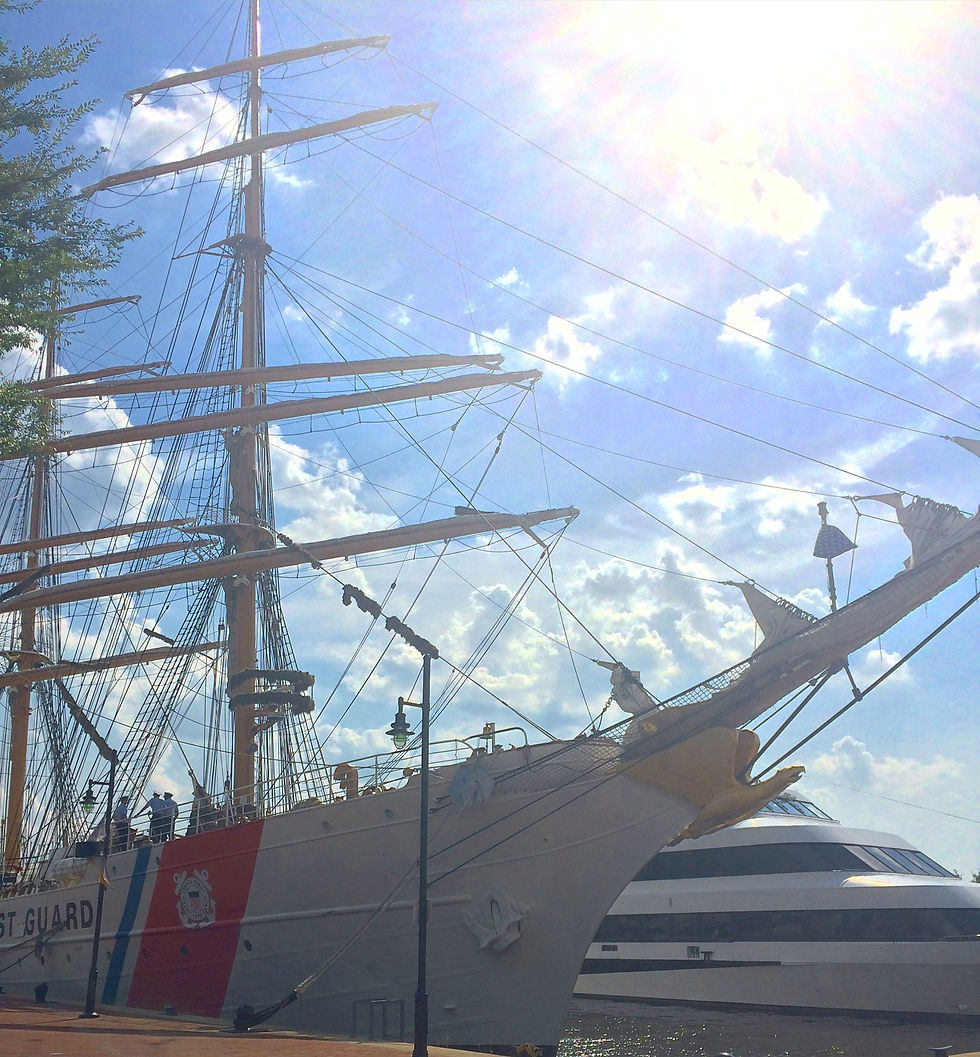
Dispelling that thought, we wandered our way to the waterfront, where we found ourselves standing before an incredible site. The USCGC Eagle; a 295-foot, 3 masted sailing ship. It was built by the Germans in 1936, and brought back to the US as a spoil of war. The US Coast Guard uses it to train Academy Cadets.
The ship was open for tours, so we spent the better part of the afternoon exploring its nooks and crannies. The masts are like great trees above your head, and the lines that run every which way around the ship are as thick as a big man’s arm. Kadin was like a little kid on a school field trip. I don’t know that I’ve ever seen him so mesmerized before or since.
There was more than one moment where we stood on the deck, looking straight up at the masts and furled sails overhead, marveling at the scale of this great ship. The rest of the afternoon was spent talking about how cool it was, and we agreed it made the city worth the stop. (I still have a portion of the brochure that tears-off and turns into a bookmark. It marks my progress in all sailing and pirate related literature.)
When the time came to cast-off from Portsmouth, we were feeling inspired, revived and ready to make progress. We putt-putt-putted down the Elizabeth River, which is a part of the Intracoastal Waterway. Various rivers and bays are connected by human-dug ditches (dug by slaves, because of course they were) deep and wide enough for small shipping vessels to travel within the safe buffer of land, instead of the open ocean along the coast. You can tell which parts of the ICW are manmade just by looking at a map or satellite view. They are perfectly straight lines between natural waterways.
As the morning opened to the afternoon, we sat for about an hour, waiting to be ushered through the Great Bridge Lock. We fended off mosquitos and watched from the boat as people came and went from the park on the banks of the waterway. eventually, we passed under the “Great Bridge” itself.
Our day of traveling ended when we reached a small park with a public dock. Rain was coming, so we hopped into our bathing suits.
Fresh water is a limited resource on a boat. You quickly learn fun ways to conserve what you have. We climbed onto the dock with soap and scrubbies in hand, and as soon as it started raining, we got to bathing. It was refreshing, if also a little stressful. (It is really tough to wash and condition your hair when you're never sure when the water will shut off.)
The rain and clouds had cooled things down to a pleasant, if humid, temp. We journeyed into the early evening to join the dozens of locals who were out catching Pokémon in the park. We got to chatting with a man who was playing on his own. He was interested in sailing, and had a few book recommendations for us on the topic. He offered to drive us if we needed to run any errands, so we took his offer and rode in his truck to a nearby dollar store so that we could pick up a few grocery items that we were missing, as well as cookie dough and a sheet that could fit into our small oven.
(Okay, so, we didn’t even really need anything. It was all a pretense to get the cookie dough.)
The next day, we continued following the ICW in a perfectly straight line. Part of the afternoon was spent floating and reading while we waited for a swing-span bridge to open. The edges of the waterway were littered with rotting wooden docks, rusting shipping vessels and derelict fishing boats. It was quiet except for the low hum of cicadas in the brush on the banks, and the occasional splash of a fish that leapt into the air to catch an insect mid-flight.
While we drifted on the still water, I finished a delightful novel called “The Little Paris Bookshop” in which a man runs a bookshop from a barge on the Seine. It had me dreaming of running my own little bookshop from our boat. It would have to consist of about a dozen books on one shelf, but I remain convinced that I could make it work.
The day wore on until finally the big ditch that held us captive transitioned into the North Landing River. We puttered through the late afternoon into the early evening until we reached where the river opens into the Currituck Sound. We anchored in the relative safety of the surrounding marshes, the sun setting over the sea grass that rustled softly as birds darted in and out, teasing out their evening meal of insects and shellfish. We slept comfortably as the cool salt air flowed through our open hatches.
The next morning, we cruised through the Currituck Sound to our next destination, Roanoke Island.
Roanoke is home to the mysterious “lost colony,” The first group of English settlers in North America who landed on the island in July of 1587, a mere 429 years before us. Not long after landing, one of their number, John White, returned to England to retrieve supplies, but he wouldn’t make it back to Roanoke until 1590. When he did, he would find that the 117 people he had left behind were gone, leaving no clues for him but a cryptic, single word carved into a post. Historians now believe these settlers were absorbed into nearby native tribes, which sounds likely considering Mr. White didn’t find any signs of plague or alien visitation upon his return. Despite the likelihood of their survival, local businesses don’t advertise it, instead playing up outcomes that better lend themselves to spooky stories for “Ghost Tours”.
As we entered the channel that leads you to the public dock and marinas of the little township of Manteo, we could see that the water around us was becoming shallow quickly. Our boat has an unusually deep draft of 6 feet, meaning we had to be more careful than modern vessels when it came to shallow water and un-dredged channels.
Just as our anxiety began to build, we were thrown forward, nonexistent brakes suddenly slammed to the floor. We had hit a high spot in the channel, stopping us cold even as the propeller continued to turn. I had mentioned at the beginning of part one that the hull of this boat is solid. Overbuilt, even. We weren’t at risk of our very own reenactment of the Titanic, but we were quite stuck. So stuck, in fact, that even putting the prop into reverse wasn’t moving us.
Thankfully, other boaters know the look of a vessel in distress when they see it. A motorboat who was slowly approaching from behind kicked it into high gear and went around us, outside of the channel, which created a very large wake. The wake lifted us up, and at the peak, Kadin threw it into high gear. We surfed our way over the sandbar, and shouted our thanks to the passengers of the motorboat, which had slowed and re-entered the channel ahead of us.
Manteo is downright adorable. The public dock has a little gazebo you can sit in to watch boats come and go on the water. On the Northernmost point of the island, you can cross a bridge to Roanoke Island Festival Park, which has a little reenactment village that depicts settler-life, as well as a museum and a working replica of the Elizabeth II, the merchant tall-ship that the lost colony arrived on. (That ship was a lot smaller than I expected. Fitting 100 plus people in it would have been some close-quarters. Probably very stinky.) We spent the evening eating ice cream and the entirety of the next day in the park, and then the museum (once again, enjoying air conditioning.)

The day we left Roanoke Island, our course was set for Oriental, North Carolina. It was going to be a very long day crossing the Pamlico Sound to reach our destination.
The sun was early in its ascent of the sky when we cast off. As we exited the southern channel of the island, we were ushered away by a parade of dolphins, their arched backs and fins sparkling in the early morning light as they greeted us with each breath they took.
The day would not end as pleasantly as it had begun.


Comments