

Today for you, Tomorrow for Me

Updated: Apr 5
Kadin and I had independently dreamt of seeing Machu Picchu, the mountain complex of Inca-era ruins in Peru. He wanted to hike the Inca Trail. I had grand ambitions of joining him. After loads of research, we eventually settled on an alternative, the Salkantay Trek. Although only a portion of this trek would include traveling along the Inca Trail, it would have the benefit of being less populated. And even better, we would be staying in permanent camps with solid buildings and showers, instead of tents. Neither of us are strangers to backpacking and sleeping in tents, but this was supposed to be vacation, and the idea of extra comfort was welcome.
So there we were, at the beginning of March 2020, sitting in front of a computer screen buying airline tickets for our 5-year wedding anniversary trip.
As you may have guessed, it ended up being a 6-year anniversary trip.
After more than a year of lockdowns and vaccinations, we were looking forward to a change in scenery.
Our first week was an incredible whirlwind of acclimating in the high-elevation city of Cusco. At the end of that first week, we had our Orientation with Salkantay Trekking, the company that would guide us and provide us with food and shelter on our trip.
They picked us up the next morning from our Airbnb, around 4AM.
We would find that they really liked waking us up at 4AM.
We piled into a bus with about a dozen other people: Our two Peruvian guides, Leo and Angel. Two men from Colombia, who became best friends during their mandatory stint in the military. Three girls from California who worked for a fitness app and all did things like trail running at high altitudes. Another woman was from California, and she was traveling with her partner from New Zealand. She was a trail runner, cyclist, mother of two, and a pilot in-training. He had just run an ultramarathon the week previous. We also had a soft-spoken German therapist who was in the country to learn about homeopathic medicine. Our final additions were a beautiful European couple. He was Italian and she was a mix of Swedish and Swiss descent. They both grew up hiking in the alps. His favorite sport was paragliding. She was a yoga teacher.
These would be our teammates for the next five days. I was sufficiently intimidated.
We rode our bus in darkness for several hours. The Andes slowly came into view through our steamed windows, as the first touch of sunlight turned the sky a dim shade of grey-blue.
Our first stop was not the trail, but a small village at the base of the mountain range. There, we paid a few dollars each to have breakfast at an open-air table. We shared what would be a common breakfast on this excursion; Hot tea, coffee, bread and jam, quinoa porridge, yogurt, granola, and a variety of fresh fruits. Once we all felt more alert, we piled back into the bus, which took us further into the mountains to our starting point. We began our hike in sunshine, several hours of moderate incline ahead of us.

When we arrived at our first camp, we were impressed. The glass igloos were neat, but they were nothing next to the snow shrouded mountains that towered around us.
We crawled into our designated hobbit-holes and put on our down-filled coats and unfurled our sleeping bags on the foam mattress that had been provided. Once our gear was secure, we went exploring. Kadin pulled out his drone. Some people went to look at the stout ponies in a nearby pasture.
Over lunch, our guides advised us to choose a team name. We settled on “Ayni” (eye-nee) a Quechua word roughly translating to an idea of reciprocity. It was explained to us as “Today for you, tomorrow for me.” Throughout our trek, we would see how each of our teammates embodied this principle.
Once lunch was finished, we began our first real hike.
Our camp sat at an elevation of around 12,700 feet. We were preparing to visit Humantay Lake, which sits above our camp at 13,779 feet. We would be required to traverse a brutal mile of incline, picking our way over loose shale and large rocks. This was, literally, a test. Whoever took more than an hour to reach the lake would need to rent a horse the next day to complete the “Seven Snakes”, the intense switchbacks that would take us to the 15,256 foot Salkantay Pass. For reference, that was about 2,300 feet short of Everest Base Camp. In Freedom Units, that's about ten and a half Empire State Buildings, stacked on top of each other.
I made it to the lake in 43 minutes, under great duress. I was nauseous and I had a headache. At the time, I didn’t know that what I was experiencing was altitude sickness. As soon as the lake was in view, I sat down on a big rock and puffed on my inhaler. Once I felt composed enough, I put on a brave face for Kadin and the rest of our team.

While taking our own photos, we met a photographer who was trekking with another company. He was the only American and the only solo-traveler within his group.
“Yeah, the guides are cool, but everyone else in the group already knows each other. They don’t really seem interested in getting to know me.”
“You said you’re the only American. Where are they from?” Asked Kadin.
The Photographer stroked the side of his face with his knuckles. “They’re all Israeli. They’re on their post - mandatory military service vacation.”
Kadin laughed. “Yeah, I’ve come across that before. They aren’t the friendliest travelers, at least the ones I’ve met so far. You wanna join our group? They might have an extra bed for you!”
The Photographer shook his head in amusement. There was a pause before he replied. I think he may have considered it, however briefly.
“Nah, I’m already paid up. No refunds. I’ll make the best of it, thanks though.”
Our guides were waving at us. It was time to go. We traded Instagram accounts, writing the usernames down in the notes app of our phones. We wished him luck and began our descent back to camp.
I ended up somewhere in the middle of the group, exceedingly happy to be going downhill. I hiked alongside the German Therapist, who was explaining to me some of the work he was doing back home. His mode of conversation was deeply philosophical, but he delivered it in a soft spoken, mild mannered way that made him pleasant to listen to. I was content letting someone else do all the talking while I focused on breathing.
It would turn out that my fight with altitude sickness had only just begun. I didn’t get to enjoy dinner with the group that evening. Instead, on my way there I would run to the privies and vomit, enter the dining hall, take one look at the fish soup placed before me, and immediately run out to vomit again.

I never went back inside for dinner. I crawled into my hobbit hole and curled up into a nauseated ball in my sleeping bag. I had hastily popped several ibuprofen for my growing headache, but it didn’t do much to quell the discomfort. I slept very little.
The next morning, once again at 4AM, we were awoken by a tap on our little hobbit door. Our guide Angel opened it up and offered us each a cup of coca tea, a common morning drink and, coincidentally, a treatment for altitude sickness. I sipped as much as I could. The nausea persisted despite the remedy.
As Kadin crawled around our little igloo packing and dressing for the cold morning, I sat on the bed, my head in my hands.
”I think I might need to take a horse. I feel awful.”
”I’m sorry babe. If you think you need to, I can go tell the guides to get us a couple reserved.”
“I know you want to do this hike. You don’t need to take a horse just because I want to.”
”I know I don’t. But I want to experience this with you. If that means I take a horse, then I’ll take a horse.”
The people-pleaser in me couldn’t accept that. I knew with certainty that he would regret taking a horse. Kadin loves to hike, and he thrives on a challenge.
“We have a little time. Let me sip on this tea and take some more medicine and see how I feel.”
Only one in our group was forced to take a horse from the beginning. One of the Columbian men who was delightful as could be, but hiked almost as slowly as myself. He took off ahead of us, his horse being guided by a local who was acclimated to the altitude and hiked up the mountain in a pair of New Balance sneakers like it was a jaunt through the downtown of a sea-level city.
The rest of us began the hike. I pushed down my growing sense of dread and opted out of asking for a horse. I quickly fell behind the group. Kadin hiked alongside me, trying to be encouraging with “You got this,” and “don’t worry about everyone else, you’re doing great”. He was speaking to my inner monologue. I never, ever share what I’m thinking, but he had guessed at it anyway. Marriage can, sometimes, make you a mind reader.
If you’re anything like me, I get in my head when I’m participating in a group activity and performing “poorly.” If I’m in the back of the group, falling down or falling behind, I feel like a failure, a loser, a burden. Encouragement sounds like condescension, judgement, pressure.
I am well aware that this isn’t a productive or rational way to function. But it is how I functioned, at least at the time. The further I fell behind, the more I began to brood. On top of feeling ill and barely being able to breathe only fed that inner voice saying “You can’t do this.”
We made it to our first stop; A narrow valley cut by streams, full of Llamas and a tiny hut selling snacks and drinks. I continued to feel awful, but I managed to make it to this point not too far behind the rest of the group. I tried to hype myself up. I puffed on my inhaler, drank some water, and followed behind the group as we began our ascent of the Seven Snakes.

I fell further and further behind. I don’t recall how many switchbacks I managed to cover. If I’m being generous, I’d say three. It was probably one and a half. Our guide Leo was hanging back with me. After getting a good look at how much I was struggling, he informed me that at my current pace, we would fall too far behind the group. To my great dismay and quiet relief, he hailed a small group on horseback being led by an older man. A girl, the horseman’s daughter, jumped off of her horse and helped me up. She led us alongside her father and their other tourists.
When the spare horse was found for me, Kadin had decided to hike as hard as he could, passing our group and not taking any breaks, so that I wouldn’t be waiting at the pass alone. When we reached the sign that announced our arrival at Salkantay Pass, Kadin was sitting against a large boulder with our Columbian compatriot, both of them trying to hide from the harsh wind. Because he had started the day on horseback, our compatriot had reached the pass a full hour before of the rest of the group. Kadin had forgotten that he had gone ahead of us.
Kadin ended up out hiking my horse and the altitude-acclimated local who guided it by at least twenty minutes.
When the rest of the group arrived, our guides instructed us to sit in a grassy patch beside the trail. Our kitchen crew and their supplies had gone ahead of us to the next camp by horse, but one of the kitchen crew was with the guides. He was a young man, and I had naively assumed he had chosen to hike with us.
As we sat, he took off his pack and proceeded to pull out a very large carafe, insulated cups, and baggies of sandwiches. Our guides handed out the food as he poured each of us a steaming cup of coca tea. The entire team was flabbergasted. The idea that this man had hiked with enough water in a heavy, insulated carafe to pour hot tea for twelve people seemed ridiculous. We thanked him for the luxury, a few joking “you-shouldn’t-haves” included. Kadin and I shared whispers of disbelief. We looked like turn-of-the-century colonizers, who treated the local people like servants while they marched-about, claiming to have “discovered” places that the locals already knew about. This would not be the last time we were confronted with this thought while traveling through the country.
The air slowly warmed as we descended down the other side of the pass, turning the sleet into a spitting rain. We were entering the Cloud Forest. The hazy, perpetually foggy altitude between the cold, high-altitude mountain tops and the warm, greenery filled forests of the greater Amazon River Basin.
The rain didn’t last long, but the air remained heavy with that ever pervasive fog. It was also laced with more oxygen, making it noticeably easier to breathe. The landscape gradually changed from rock and scrubby grasses, to leafy bushes and the occasional orchid.
Our lunch destination came into view, a long shack just off the trail. It consisted of a simple food-prep area and a separate space housing long tables and benches. There were also, in the most technical sense, restrooms. Adjacent to the dining shelter was another shack with a few stalls, all made of moisture laden wood and rusting nails.
I expected these to house privies, much like the vault toilets you find in the remote state and national parks in the US. I was amused to find that they housed actual porcelain, flushing toilets. However, they were missing an essential component: seats. There were none of those U-shaped plastic seats you’d expect to find on a toilet. Even the vault toilets I’ve used had seats. Instead, there was only the wide, bare rim of the cold porcelain itself. To make matters worse, I had chosen one that had suffered what appeared to have been an all out assault by someone who had a very, very bad day.
I’m no stranger to squatting outside while camping, but hovering over this vast expanse required muscles I did not know I had. This proved to be nearly as challenging as the hike itself.
Our next camp sat in a little valley full of eco-tourism encampments, private homes, and a waterfall. All of these were cradled by imposing mountains of lush greenery.
Our sleeping arrangements for the evening were little wooden “Andean Huts”. They were A-frames with grass roofs. We dropped our bags on the floor and dug out some cash, which we gave the host as payment for the shower house. We played a sort of Russia roulette with the water temperature. I got lucky, being graced with hot water. One of the California girls who inhabited the stall next to me yelped when freezing water hit her back. Kadin described his shower as “not the temperature I was hoping for”.

Later in the afternoon, Kadin set up his drone so that he could take some videos. Everyone gathered 'round in the grassy area in front of our huts, standing together in a group like you would for any photo. We waved as the drone descended through the air and flew towards us. The plan was for the proximity sensors to auto-stop the drone as it came within six feet of us.
It didn’t stop.
To understand what happened, we have to rewind.
After several days of exploring Cusco, Kadin wanted to document the adorable Spanish-style courtyard of the apartment we were renting. The courtyard was surrounded on all sides by the two story home that contained it. The space was so small, that in order to get the drone to fly at all, the proximity limiters had to be turned off.
We forgot to turn them back on.
So here we are now, a group of people smiling and waving, jumping up in the air expecting this little flying robot with four sets of spinning plastic blades to stop before it reaches us. In the video, you can just barely catch the recognition in some of our faces as we realize it isn’t going to stop. It buzzed right over our heads and slammed into the wall of one of the Andean Huts behind us. The drone landed upside down. It is supposed to turn off when it is upside down. Probably due to the hit to the wall, the drone didn’t get the memo and the blades continued to whirl furiously, breaking apart as they dug into the rocks and dirt on the ground. In his panic to prevent further damage, Kadin picked it up to turn it off. His first instinct was to apologize to our teammates, trying to explain how this had happened. Everyone laughed it off, happy to not have taken a drone to the face. I glanced down and noticed that the drone was covered in blood.
“Oh my god Kadin, did it cut you?”
“Huh?” He said concisely.
I took the drone from him as he inspected his left hand to find that the blades of the drone had sliced deep gouges into the tips of his index and middle fingers, cutting viciously down the middle of the nail-beds. Kadin isn’t one to fuss over an injury, but he was appropriately shocked at the sight.
Our guides jumped into action and retrieved a medical kit. One of our teammates, the New Zealand ultramarathon runner, was a nurse by trade. He offered to take over, and got Kadin’s wounds cleaned and wrapped. By now, the shock was gone and the pain had set in. Kadin crawled into our little hut, taking some time to let the ibuprofen soak in before joining the rest of the group for dinner. I knew that he was also mortified that he could have hurt someone else with his mistake. He eventually rallied, but the pain in his fingers would plague him for weeks to follow.

The morning of day three had us gathering at a more reasonable hour. I taught some of the girls how to do twists in their hair like mine, an alternative to braids. The day’s hike was fairly easy, consisting of a few long hours following a winding road through the mountains. Our guides stopped us occasionally to point out a flower or berry, educating us on their cultural and medicinal significance. As I took pictures along the way, I asked Kadin to pose. He continued to hike ahead, but he threw his left hand in the air, giving me a peace-sign with his injured fingers.

One of the California Girls laughed. “I think we need to make that our team gang sign!” She made a peace-sign with her left hand, and several of us followed suit. I’m not sure if Kadin was amused or defeated.
We stopped at a little group of buildings on the side of the road. It felt like we were in the middle of nowhere, but there were quite a few people hanging out, waiting for buses to take them elsewhere.
One stand sold local produce; Passion fruit, Lucuma, Golden Berries, and Bananas. Another made egg and cheese sandwiches and sold drinks in plastic bottles. Kadin bought local honey, which he packed into his wounds before redressing them. He will later swear by this as the reason why he has no scars leftover from the drone incident. It was also here that we ran into the Photographer we had met at Humantay Lake on day one. It didn’t sound like his group dynamics had gotten any better, but he was a good natured person and seemed to be making the best of it. We were happy to spend the next thirty minutes sitting in the sun and chatting with him.
Due to poor trail conditions, we were taken by bus to our next lodging. We rode for maybe forty minutes around narrow mountain roads, our wheels mere inches from the edge of a drop-off into dead space. In some places, the road became wide, perfectly level, and covered in gravel. Our guides explained that there had been landslides.
“They haul a big bulldozer up here and plow a new road through the pile of loose soil.”
Kadin chuckled. “That doesn’t sound very stable.”
“It’s how things get done around here.”
Our Italian teammate was seated on the left hand side of the van, his face pressed against the glass of the window.
“Guys, you really need to look at this. The wheels are only inches from the side of the road! One wrong move, and we’re going down this mountain.”
He said it excitedly, with a touch of laughter. Kadin climbed over to look out the window too.
Most of the team shared nervous glances, or closed their eyes tightly. Reading the anxiety in the tight space only encouraged him to continue.
”Seriously, we are so close to the edge! this is crazy.”
One of the Califonia Girls snapped at him anxiously. “Please stop. I do not need to hear this!”
”Ahh, the driver does this all the time. We’re probably fine. But you should really see this, it just drops straight down!”
”Okay, stop it!” His girlfriend chided him. He stopped. Kadin was laughing like a maniac as the van ambled on.
Because of the closed trail, we were left with an entire afternoon to kill. Most of us opted to visit a local hot spring. Unfortunately, it required yet another treacherous bus ride that included a bridge that was barely holding on. It was in such bad shape, most of the crew cheered when we made it to the other side.

We woke up early the next morning to chilly air and foggy skies. This was the last day of the actual trek, where we would cover a section of the Inca Trail. Our reward at the end of the day would be real beds in a hotel in Aguas Calientes, the gateway to Machu Picchu.
The trail was a never-ending upward climb of ancient stairs. Again, I struggled. Kadin tried to provide words of advice and encouragement as I huffed up the stairs. I snapped at him. He took the hint and hiked ahead, enjoying the company of some of our more positive teammates, which suited me just fine. I wanted to bask in my misery alone.
As my fellow turtle from Columbia and I fell further behind, we came across a couple of the California Girls who had stopped to take a break. This didn’t make sense to me, considering how they had power hiked the more difficult trail of day two. They spent the better part of the morning with us as we ascended. They made light conversation with us as they hiked at a steady but noticeably slower pace. I suspected that this was an intentional choice on their part to keep our spirits up.
We took several breaks along the way. The first was at a small overlook that had a large swing. It was made so that when you swung out as far as possible, nothing would be underneath you. For just a brief moment, you would be suspended in the air above the mountains and feel like a bird. I had seen this spot on social media and tour guide websites, and it was one of the things I had been looking forward to.
When it came time for me to actually do it, I chickened out. I was in such a negative head space, feeling like I was holding the group back, certain that I looked out of shape and weak. I couldn’t climb out of the negativity pit in my mind. As I sat and caught my breath, I couldn’t stop thinking “You should just do it,” while being too paralyzed to follow through.
It’s hard to describe this feeling to someone who hasn’t experienced it. I have, on many occasions in my life, missed out on things that I have a strong desire to do. Classes, social interactions, new experiences. Time and time again, I find myself on the fringes, desperately wanting to jump in, to do-the-thing, while my body shuts down. And then I cry, because I feel trapped. My body isn’t doing what I’m asking it to do.
By this point in time, I had done the work and sought out treatment for my depression and anxiety. But I was only a few months into it. Although there is no perfect recovery from behaviors that have tattooed themselves on your nervous system, I can happily tell you that this phenomenon occurs far more rarely than it used to.
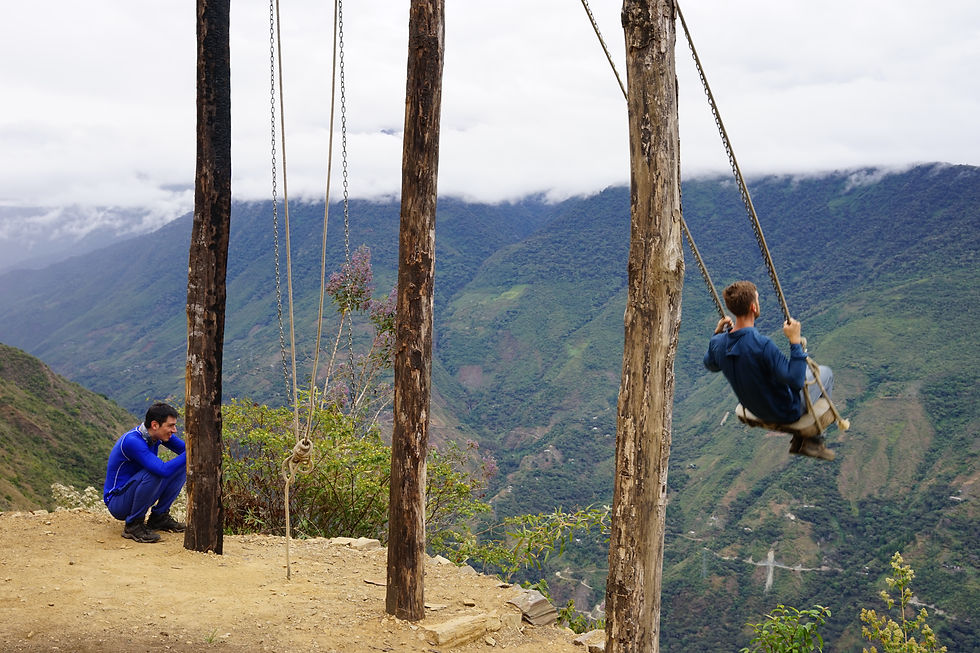
When the break was over, we left the swing behind us. I spent the next several hours mentally flogging myself for missing out on the opportunity.
We stopped at another overlook inhabited by ratty looking jungle dogs and an over-abundance of flies. One of the California Girls spent the entire time waving her arms and spinning in circles in an attempt to subvert the aerial swarm.
From this overlook you could just make out the outline of Machu Picchu across the deep valley. It was hard to believe that we would hike around that gaping chasm in one day.
We hiked on, only to arrive at yet another overlook. I was beginning to understand why we got up so early. We needed time to make all of these stops.
This overlook also held a small stand of ruins, named Llactapata. While exploring the ruins, we came across the Photographer, who had peeled off from his group during today’s hike so that he could enjoy taking photos at his own pace. We hung out with him for awhile, posing for pictures and talking about what we had seen up until this point. It would be the last time we ran into him.

At the base of the mountain, we crossed a swinging bridge over a river. Kadin had way too much fun jumping on the bridge, throwing everyone else off balance.
Thus began the long walk alongside the train tracks. This portion was described by most of the group as the “worst part”. It was a very long, very flat walk. It proved to be uneventful, aside from the rain that had us donning plastic ponchos, which did little to keep us dry. It was so hot that wearing them only turned us into walking greenhouses.
I didn’t find it to be all that bad. I grew up in the middle of Indiana, aka Cornfield USA. My brother and I would walk for miles along the train tracks that cut through our little town, perpetually drenched by the humid summer air. This path was flat and easy, and I had several podcasts to catch up on. I popped in my earbuds and moseyed my way to Aguas Calientes, feeling a little bit like a kid again.
It is probably an understatement to say that we were delighted when we finally checked into our hotel. Our gear that was sent ahead of us by bus was waiting in the lobby. We all checked in, looking forward to hot showers and a meal in a restaurant accompanied by beer and pisco sours.
We met with our group for dinner at a cute little place with live music. We drank and made merry, celebrating our survival. Not thinking - or perhaps wholly avoiding - the fact that we would wake at 4AM the next day to begin our ascent of the more than 1,600 stairs to the entrance of Machu Picchu. We would once again struggle our way ever upwards, watching the sun rise on the valley, drenching ourselves in sweat before most people had drunk their first cup of coffee.
Before the night ended, our guides asked us to go around the table and share our “Worst Part” and “Best Part” of the trip. The worst part for a lot of people was the hike along the tracks, or the scary van ride through the mountains. For Kadin, it was his injury from the drone. (This was his worst part so far. He had not yet developed the migraine that would keep him up all night until the aforementioned ascent of the stairs to Machu Picchu.)
When my turn came, I knew my answer immediately.
“The worst part for me was having to take the horse on the second day. Because I felt like I failed. I really wanted to do this hike, and I don’t really feel like I accomplished the whole thing.”
The group nodded and mumbled soft words of encouragement and understanding.
“And the best part? That was also the horse. I really, really needed that horse.”
The group laughed, and so did I.


Comments